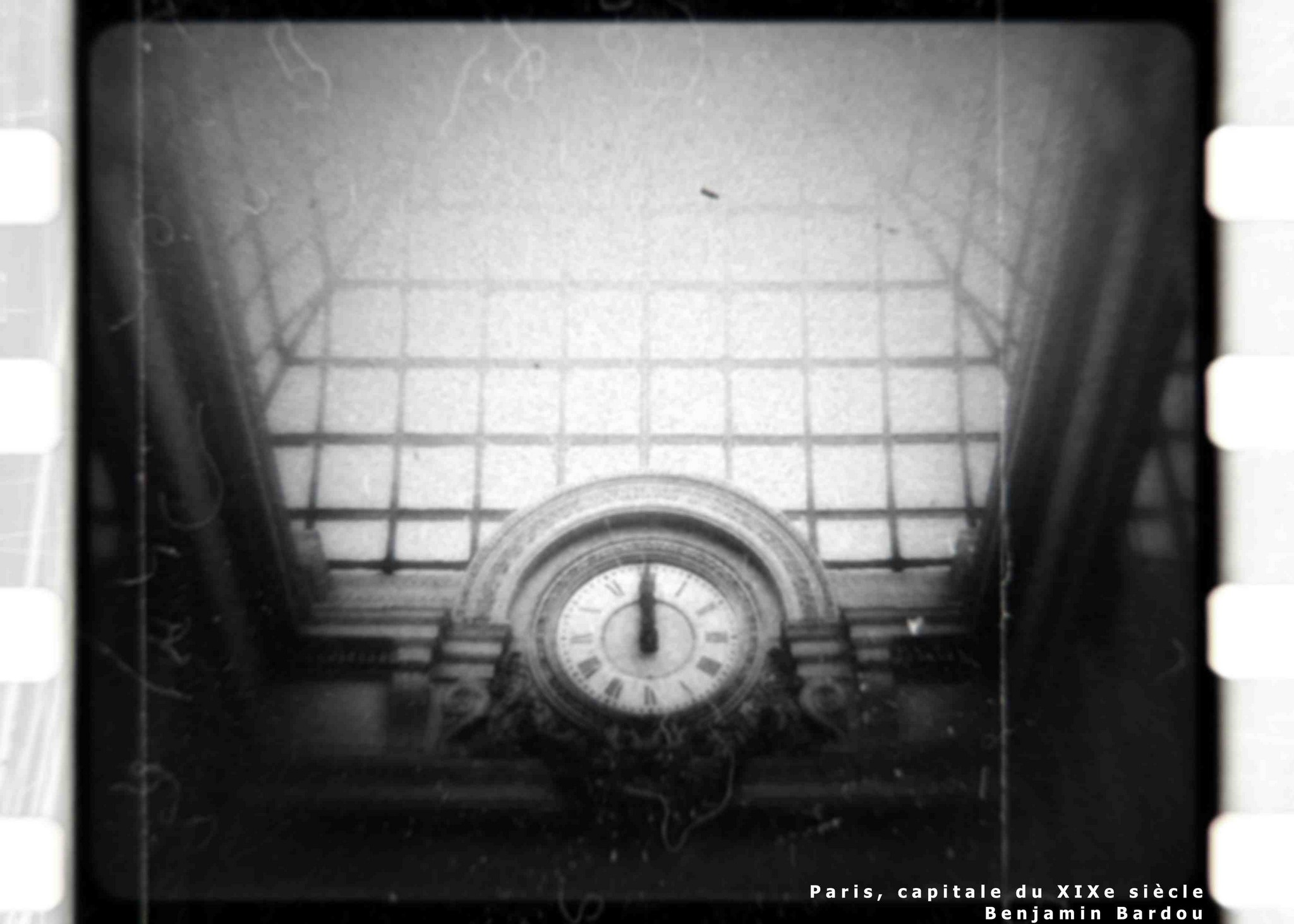
In his book "Paris, capital of the 19th century" the German philosopher Walter Benjamin attempts to outline a comprehensive interpretation of then19th century along with its dubious modernity. He argues that ìcapitalism was a natural phenomenon which plunged Europe into a new, dream-filled sleepî. Therefore, in Paris, capital ñ through Haussmannís work - reshapes urban space and time. All this brings about a new experience for town dwellers, a feeling very well described by Baudelaire in his poems ñ the large town shock. In his ‘Eternity by the Stars’ Blanqui describes it a hellish vision, an endless return of the same. At this time, new reproduction techniques emerge, such as lithography, photography and film-making, which enable us to understand the traumatic shock of urbanism by including it into their own devices (a film, after all, is a series of 24 shocks per minute!) As these techniques acquired art status, they create an urban and world- encompassing fantasy (by means of sample-sites such as the bourgeois interior, passages, department stores) and succeed in producing a perceptible and reassuring image. In short, they become phantasmagoric. Nowadays, films should still make us dream. But current film-makers do not film reality, in the same way they didnít film Auschwitz. If they did, they would relay the picture of a world in ruins. For this reason, film-making must serve as a wake-up call, and help mankind live in the present and no longer in the dreams and myths of the 19th century. In a sense, it must be political. As this film attempts to point out.
Credits